Husky Nike Tech references: choose the top and trousers
A tech-fleece enquiry works best when the top and trousers are identified as two garments.
Free shipping from 3 items; under 100 USD or 100 EUR per item, not a landed total; retail and wholesale available. Ordering details.
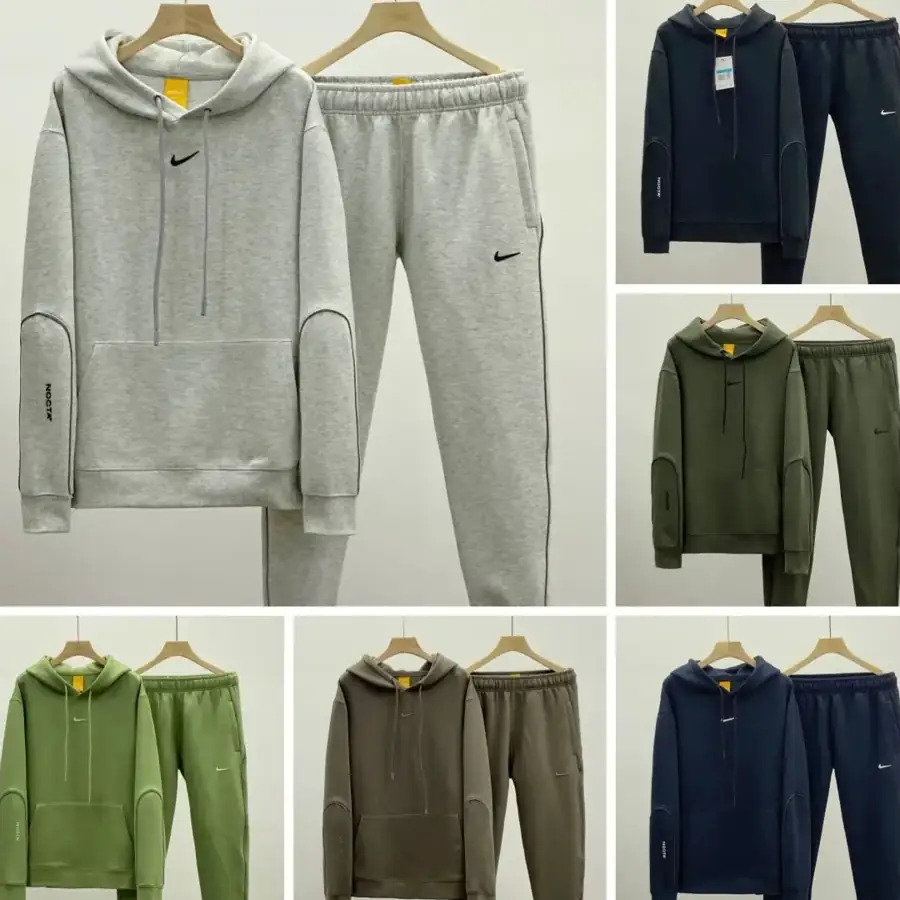
Use the grey hoodie-and-pants picture to discuss the overall silhouette, then confirm the details of each piece.
Decide whether you want a set or one separate
The main reference here shows a grey hoodie with coordinating pants. A black fleece zip jacket and a navy fleece jacket provide other top shapes to discuss, but they do not automatically identify matching trousers. State whether you want a complete outfit, a replacement top or trousers to pair with clothes you already own. A photograph of two pieces is not a promise that both are included in a single item price.
If you arrived looking for Husky Nike Tech, include any garment code you saved alongside that name. We can use the reference to clarify the cut without assuming a fabric specification, retail season or brand status. When an album title combines two codes, copy both and mark the piece attached to each one. This is particularly helpful when several grey sets look similar in a small thumbnail.
Read the top from shoulder to hem
Begin with the neckline: hooded and non-hooded tops frame the upper body differently and change how another jacket sits over them. Then inspect the front opening, pocket position and lower hem. A top worn zipped to the neck can look shorter or more structured than the same garment worn open. Ask for both views when the front shape is part of your choice rather than relying on a single styled pose.
For measurements, request underarm width, body length and sleeve length with the measuring method stated. If the shoulder seam is clearly defined, shoulder width may also help. Where the sleeve joins differently, compare the same points on a garment you own rather than forcing an unsuitable shoulder measurement. A roomier chest does not necessarily give more sleeve length, so keep those preferences separate.
Cuffed ankle or open hem?
The grey trouser reference has a jogger-like outline. If you want a cuffed ankle, say so; if you prefer the leg to fall open, request an open hem explicitly. Open-hem fleece trousers and cuffed joggers can share a general description while looking quite different over footwear. Choose based on the ankle you want to see, not on the word “fleece” alone.
Check the thigh and lower leg as well as the waist. A waist that fits comfortably can still lead to an unwanted tight calf or a leg that stacks too much above the ankle. For an open hem, ask about leg opening width and intended inside length. For a cuff, consider where you want the cuff to sit when standing and sitting. Do not use “unfinished” as a substitute for “open”: hem finishing is a separate detail to confirm.
Make the measuring comparison useful
Lay a comparable top flat, smooth it gently and measure across the underarms. Measure body length from the high shoulder point to the lower edge. For trousers, measure the waistband relaxed, the front rise from the crotch seam to the top of the waistband and the inside leg from crotch to hem. Note the unit and avoid stretching elastic while recording the starting width.
Send those numbers with a sentence about your desired change: “Keep this chest room, add a little body length” is clearer than “size up.” Ask us to compare the selected garment rather than transfer a size letter from another item. If a chart uses body circumference instead of garment width, establish that difference before choosing. The two types of number cannot be compared directly without knowing what was measured.
Matching grey is more than choosing a colour name
When top and trousers will be worn together, request a photograph showing both under the same light. A matching label such as grey or charcoal does not guarantee that two separate references have the same shade. Surface texture and lighting can also make one half look darker. State whether a coordinated appearance is essential or whether you are deliberately combining different tones.
If we propose a different piece, compare the new code, cut and colour against the first choice. Approve that change explicitly rather than treating any grey top as equivalent. For a replacement separate, a photograph of your existing garment can help describe the tone, but it cannot guarantee an exact match through a screen. We should discuss that limitation before you rely on the two pieces looking identical.
Use a model note as context, not a size instruction
Some reference titles include the model's height, weight and worn size. Keep that note if it helps locate the photo, but it describes one wearer and one pose. Two people with the same height can need different rise, sleeve and chest measurements. Your preferred fit may also be different from the model's. A close fit through the calves and a loose fit through the chest are two separate requests.
Album year numbers can be useful identifiers, too. They should not be read as independent evidence of material, construction or retail-year equivalence. If the distinction between two folder references matters, ask which visible details differ and request the relevant pictures. We would rather compare a pocket or hem you care about than promise specifications that a folder name does not establish.
Wear the set as a pair or break it up
For a coordinated look, keep the top hem and waistband relationship in mind. A longer hoodie may cover the top of the trouser shape; a shorter zip top makes the rise more visible. If you mostly wear the pieces separately, choose each for its own fit instead of compromising both to keep one size letter. Ask whether your selected top and bottom sizes can be combined in the quote.
The tracksuit page compares other complete-outfit references, including lettering and colour-block combinations. For a puffer layered over fleece, compare the jacket's internal room with your chosen top, not just your body measurements. You can send both references together and explain that they will be worn in layers so the fit discussion accounts for the whole outfit.
Your tech-fleece enquiry card
Send the top code, trouser code, colour, requested sizes, quantity and destination. Add cuffed or open hem, your comparable garment measurements and whether colour matching is essential. If only one piece is required, put “top only” or “trousers only” near the beginning. This small amount of organisation prevents an outfit picture from becoming a vague bundle request.
The pictures on this page are catalogue comparisons rather than Husky album photography. We provide photographs of the exact ordered items before onward shipping; use that stage to check the agreed top, trousers, labels and important visible details. For the complete buying sequence and terms, continue to ordering information after the garment decisions are clear.
Related pages
Questions
Can the hoodie and trousers have different sizes?
Ask us to quote the two requested sizes against the specific references. Do not assume that a pictured combination is supplied only as one fixed size.
Does tech fleece tell me the fabric composition?
Not by itself. Request the composition and care information for the selected garment if those details affect your choice.